How Page Load Speed Affects Your eCommerce Conversion Rates
In the “millisecond economy,” website speed serves as the foundational layer for trust and engagement. So if your interface is slow, the user assumes your business is incompetent. Research consistently shows that website speed directly influences their purchase decision.
If a site fails to render content instantly, it triggers a stress response known as “Time Theft”. Unlike pricing, lost time is irreversible. So, the “conversion cliff” begins immediately. Plus, speed impacts every stage of the funnel, from discovery to checkout. So, prioritizing speed is crucial to prevent revenue leakage.
This article focuses on how page load speed affects conversion rates, the impact on first interaction, and how to leverage it for your business.
Page Load Speed as a First-Interaction Signal
Website loading time can significantly impact user perception, especially with slower speeds damaging the brand’s perceived reliability and legitimacy. Users often form their first impressions about your website in milliseconds. During this first interaction, users subconsciously evaluate a site across multiple perception cues tied directly to loading speed.
- Implied Professionalism – A responsive website not only impresses users but also instills a brand image of professionalism. A faster loading website reflects an efficient and well-managed brand.
- Outdated Perception – Slow websites often indicate the use of outdated technology or poor website management, which creates a doubt in the user’s mind about a business’s competence.
- Expectation Violation – Users expect instant gratification in the digital age, and a slower website means delayed gratification. This leads to cognitive friction, making users think there is something wrong with the website.
Slower websites also signal risk for users. What this means for a business is erosion of user trust, damaged brand reputation, and lost conversions.
Especially for eCommerce sites, page speed becomes a key trust indicator. Slower loading of eCommerce websites signals security risks and unprofessionalism. Users question the legitimacy of a site due to slower page speed.
How Load Time Directly Influences User Behavior on eCommerce Sites
The statistical analysis shows that any slight variation in load time is enough to increase the chances of user abandonment significantly.
The probability of bounce increases exponentially with the increase in the delays. Most of the users, will drop an entire site completely if it takes too long to load. Increased bounce rate kills the depth of the sessions, resulting in fewer completed sessions and weak behavioral clues.
If the interface is sluggish, product discovery halts. Delays in loading category pages reduce the likelihood that users will progress from a product detail page to the “Add to Cart” stage. And micro-delays effectively shrink your visible inventory by preventing fluid navigation.
Plus, a slow-loading website disrupts the entire shopping momentum. It creates friction, which stops the “psychology of buying”. Fast-loading websites help your brand create a perception of quality, which improves brand trust. So, a faster-loading website is crucial to maintaining the flow required for conversions.
Many of these improvements are best implemented through professional web development services, which confirm fast, secure, and user-friendly shopping experiences while aligning with business goals.
Impact on Mobile Users
Mobile shoppers are specifically sensitive to delays during the purchase of a product on eCommerce site. This is due to the browsing on the go experience that users seek from a mobile device, where mobile-first design is treated as the default rather than an exception. Sensitivity towards slower loading sites is often due to expectations set by fast mobile networks. This sensitivity directly leads to higher cart abandonment rates.
Other key impacts on the mobile users are,
- Slower websites often break the flow of micro-moments or quick bursts of activity while multitasking on their mobile devices.
- Faster 5G networks and highly optimized apps like Instagram and others have created expectations among users.
- Mobile environments can be more distracting than desktops, and when the page speeds are lower, users tend to switch to another app to check a notification or resume other activities.
The Relationship Between Page Speed and Conversion Rates
In the current competitive market, room for error is small. Even minor inefficiencies measured in fractions of a second can introduce delays that reduce conversions, profitability, and revenue. Industry data consistently shows how even marginal delays translate into measurable revenue loss.
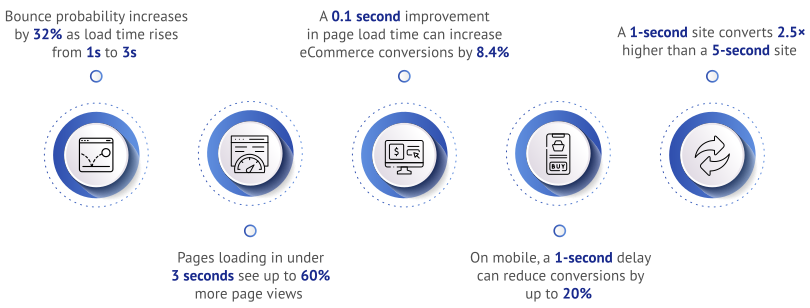
Together, these metrics reveal a consistent pattern: speed influences trust, confidence, and momentum throughout the conversion funnel.
Where Page Speed Breaks the Conversion Funnel
ECommerce conversion funnel has several stages. The first phase is the initial landing, the second is product discovery, and the third is the add to cart phase, or often termed as the micro-conversion. The final phase is checkout.
Users are most sensitive to page speed during checkout. And this sensitivity declines as you move backwards from the final stage to the first stage. So, page speed will have the greatest impact on the micro-conversion and checkout phases.
Early-stage delays can alter a customer’s impression. So it may seem that you only need to focus on the final phase, but page speed is crucial to your entire site.
Page Speed vs. Other Conversion Optimization Factors
Page speed functions as the baseline for all conversion optimization efforts. While elements such as content relevance, value proposition, user experience, mobile usability, and trust signals influence conversion intent, their effectiveness depends on how quickly users can access and interact with them.
Design, copy, promotions, and paid traffic can attract users and shape purchase decisions, but slow load times undermine their impact by introducing friction before engagement can occur. When performance issues persist, incremental UX improvements or campaign optimizations rarely compensate for the resulting abandonment. In practice, speed improvements often deliver stronger conversion gains because they remove the fundamental barrier that limits every other optimization layer.
| CRO Factor | Primary Role | Impact When Page Speed Is Poor |
| Page Speed | Enables access, interaction, and flow | Direct abandonment, reduced trust, lower conversions |
| Design & Layout | Guides attention and usability | Users exit before layout influences behavior |
| Copy & Messaging | Builds intent and persuasion | Messages are skipped due to impatience |
| Promotions & Ads | Drive traffic and demand | Ad spend ROI drops due to early exits |
| UX Enhancements | Reduce friction and improve clarity | Gains are muted when performance lags |
| Trust Signals | Minimize hesitation and increase confidence | Signals go unseen or are distrusted |
Technical Factors That Commonly Slow Down eCommerce Pages
Identifying bottlenecks is the first step toward remediation. In the eCommerce sector, performance issues are rarely caused by a single error; they are cumulative. Our developers at FTI Tech analyze these bottlenecks and implement effective performance improvements.
Heavy Media and Scripts
The rich media and third-party integrations are the primary factors that make web performance slow.
- Image Weight: When the images are not reduced or turned into WebP images or AVIFs, then they are the ones that slow down Largest Contentful Paint (LCP).
- Script Bloat: eCommerce sites are more likely to load third-party code than they are to load first-party code.
- Execution Delays: These scripts compete for the browser’s main thread, blocking interactivity.
Platform and Hosting Constraints
Your infrastructure defines your maximum potential speed.
- Shared Hosting Limits: Many businesses rely on shared hosting to save costs. But this leads to inconsistent performance during traffic spikes.
- Mobile Infrastructure Gap: Mobile devices have slower CPUs, meaning unoptimized assets take longer to process.
- Distance Latency: Physical distance from the server adds delay. Sites without a Content Delivery Network (CDN) can have high Round Trip Times (RTT).
Measuring Page Speed in Terms That Matter for Conversions
Raw load time is a misleading metric. It does not reflect how a user perceives speed. So, to correlate performance with user behavior, the industry has standardized measurement around Google’s Core Web Vitals (CWV) framework.
The program has been dedicated to three pillars of the user experience, including loading, interactivity, and visual stability. To achieve the target of abandonment reduction, it is necessary to meet the Good thresholds for the metrics.
- Largest Contentful Paint (LCP) is a measure of perceived load speed. It is divided by the time that is required to display the main product image or banner.
- Interaction to Next Paint (INP) is a responsiveness metric that measures the time it takes for the site to respond to a tap or click.
- Cumulative Layout Shift (CLS) gauges the stability of the visual. It measures the unforeseen relocation of elements.
Conclusion
The page load speed is no longer a technical issue. It is a radical change in the business. A change in a 3-second site to a 1-second one can increase the conversion rates by two times and save a lot of money on customer acquisition expenses.
The greatest competitive advantage is page speed, and that is why upgrading your infrastructure to be able to provide it immediately before you invest in a new copy or design makes more sense. If you want guidance tailored to your business, our team is always ready to help, Contact us today.