Motion Graphics for Business: Boost Engagement, Trust and ROI
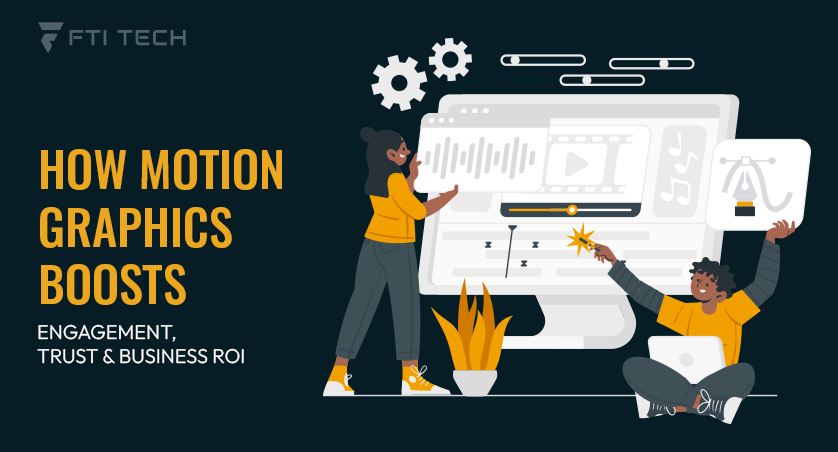
Motion graphics are animated visual elements, from the subtle micro-interactions in a user interface to full-scale explainer videos. It is designed to guide, inform, and convert users. They are a communication tool, a measurable one, which improves engagement, trust, and ROI. Let’s understand how.
Why Static Content is Losing the Battle
Static content makes users do too much work, and in today’s digital world, that work often leads to missed chances. This usually shows up as hesitation, a pause right at the moment a decision should be made.
Users click a button, but nothing happens right away. A part of the layout suddenly changes, which is jarring and forces the user to figure out where they are again. When a form is sent in, but the interface doesn’t give clear feedback, it causes doubt. Users are left wondering, “Did it work?” Is the page coming up? Should I click it one more time?
That friction builds up quickly. The main problem isn’t that static design. It’s that static experiences often don’t do one very important thing – communicate the cause and effect. The experience feels a lot less reliable when interfaces don’t respond in a way that users can read right away.
The same pattern can be seen in marketing. A static ad has one shot, with no direction, no pacing, and no visual cue to tell users where to look first. So they don’t look. Or they glance and move on.
This is why the shift toward motion-first web design isn’t just a visual preference – it’s a strategic response to how users actually behave online.
How Motion Graphics Capture Attention and Improve Engagement
Users’ brains are wired to notice movement, so motion is noticed right away. It automatically draws attention and cannot be ignored. In digital spaces, movement is an instant visual cue that something is going on. It stops mindless scrolling and draws attention to a specific element, message, or action.
But motion design that works really well does a lot more than just get users’ attention. It creates a guided visual flow and actively controls how users take in content. Such a design guides the user’s eye exactly where to go next, in what order, and at what pace.
Creating a Visual Hierarchy That Guides Decisions

Movement in design helps create a clear visual hierarchy. A strong headline comes first, followed by the product, and then the call to action. Such a sequence makes the user’s brain predict the flow, reducing cognitive load. Plus, it breaks down dense information into smaller steps. This kind of behavior is naturally rewarded by digital platforms.
The main goals of social media and search algorithms are to increase watch time, meaningful interaction, and overall retention. Because motion content naturally makes users stay longer and see more, it leads to higher engagement on social media, websites, and email campaigns.
Building Trust Through Motion Design
How interfaces respond is just as important as how they look when it comes to trust in digital environments. When users interact with a product, they are always getting subtle feedback from the interface, a tap, a state of hovering, a confirmation. When done with intention, motion makes things clearer, more predictable, and gives you a deep sense of comfort.
Motion design directly deals with a number of important trust-building factors:
- Visual feedback: Simple animations show that the user did something, like clicking or submitting a form, which shows that their effort was worth it.
- Smooth transitions: These visually link cause and effect, which is especially important in complicated sequences like add-to-cart or checkout flows.
- Handling errors: Animated cues can help users fix things without making them feel like they’re being punished or causing problems.
- Consistency: Repeated, predictable motion patterns make the whole platform more reliable.
It actively lowers anxiety during times of high risk, like when you’re entering payment information, filling out long registration forms, or completing a multi-step checkout. Motion fills the gap between a cold software interaction and a trustworthy digital experience by making interfaces feel more human and responsive right away.
This is one reason why our approach to responsive web design at FTI Tech always accounts for interaction behavior alongside visual structure, because the two are inseparable in how users judge a product.
Core Applications of Motion Graphics Across the User Journey
To really get what motion design is worth, we need to see where it works best in real life without making the user feel overwhelmed. There are different types of movement that are needed at different points in the user journey:

- Micro-interactions: These happen the moment you hover over something in the UI. Small, quiet signals. They build trust in the interface and make every point of contact feel less like guesswork.
- Product explainer videos: They collapse a complicated value proposition into seconds for SaaS, fintech, and tech-savvy brands. You’re not just showing what a platform is. You’re showing how it actually works.
- Landing pages: When used in restraint, motion-first assets get more attention at first and convert better down the line than static assets. The key is placement; motion should guide the eye toward the primary offer. Our custom layout design process factors in animation hierarchy from the start, so motion serves the conversion goal rather than distracts from it.
- Onboarding flows: Animated tutorials and guided walkthroughs cut through the initial confusion faster than any FAQ page ever could. Users find their footing sooner. Support tickets quietly drop. And the time between “I just signed up” and “okay, I get it now” shrinks to something actually reasonable.
Direct Impact on Conversions and ROI
Motion isn’t just a way to get users interested. It is a working system that leads to measurable business results. The most obvious effects on performance can be seen in how users convert. Companies always say that animated CTAs and interactive product demos lead to higher conversion rates.
Because the interactions are guided, and more engagement naturally leads to more qualified, high-intent interactions. By lowering friction, motion makes sure that users have a smoother experience from the first touchpoint to the last click.
There are a number of other behavioral changes that back up these results. Users always stay on pages that have motion for longer. Because motion makes things much clearer, it helps users make decisions faster and with more confidence. In the end, video and motion assets have a big impact on the final decision to buy. More engagement, better retention, and clearer messaging all lead to more conversions.
What Makes Motion Graphics Work?
Motion only works when it has a specific purpose, even though it has many benefits. It must be planned and purposeful, not just for show.
There are strict rules for good motion design. It needs animation that has a clear purpose and helps, guides, or calms the user. It depends a lot on having consistent timing and smooth transitions, as well as a clear visual hierarchy and sequencing.
Poorly optimized animations can cause serious technical problems, like slow page load times or laggy interfaces, which quickly break trust. Good movement is invisible and feels completely normal.
Conclusion
Motion graphics help with three main digital problems: getting users’ attention, making things clear, and keeping them interested. They change the way users interact with the system from a passive, static way to an active, guided way.
This effect goes all the way through the marketing and product funnel, smoothly taking users from Engagement to Trust to Conversion and finally to ROI. Motion is no longer just a visual trend. It’s a useful, measurable, and strategic tool for growing your business online.
If you’re thinking about how motion design fits into your website, or digital product or you’re ready to build something that genuinely converts, contact us to discuss your project directly.